
Many adults who come to see us have called their eye misalignment a “lazy eye” for most of their lives, and many were told long ago that they would simply have to live with it. If that sounds familiar, you are in the right place. An adult strabismus consultation is a gentle, painless visit that measures exactly how your eyes are misaligned, and most people leave with a clear medical diagnosis and a set of treatment options. Here is what to expect, step by step.
What Is an Adult Strabismus Consultation?
An adult strabismus consultation is a specialized evaluation of how your eyes line up, how they move, and how they work together as a team. At PES Adult Strabismus Center, this visit goes well beyond a routine eye exam, giving you precise measurements and a clear understanding of what is behind your eye misalignment.
A typical eye examination checks how clearly you see. A strabismus consultation, also called a sensorimotor examination, looks at your alignment, your eye movement, and your binocular vision, which is the ability of both eyes to blend what they see into one image. You will usually meet with a certified orthoptist first, a specialist trained to measure how your visual system works together, and then one of our surgeons, all board-certified in ophthalmology, reviews the results with you. Learn more on our About Adult Strabismus page.
What Should I Bring to My Strabismus Consultation?
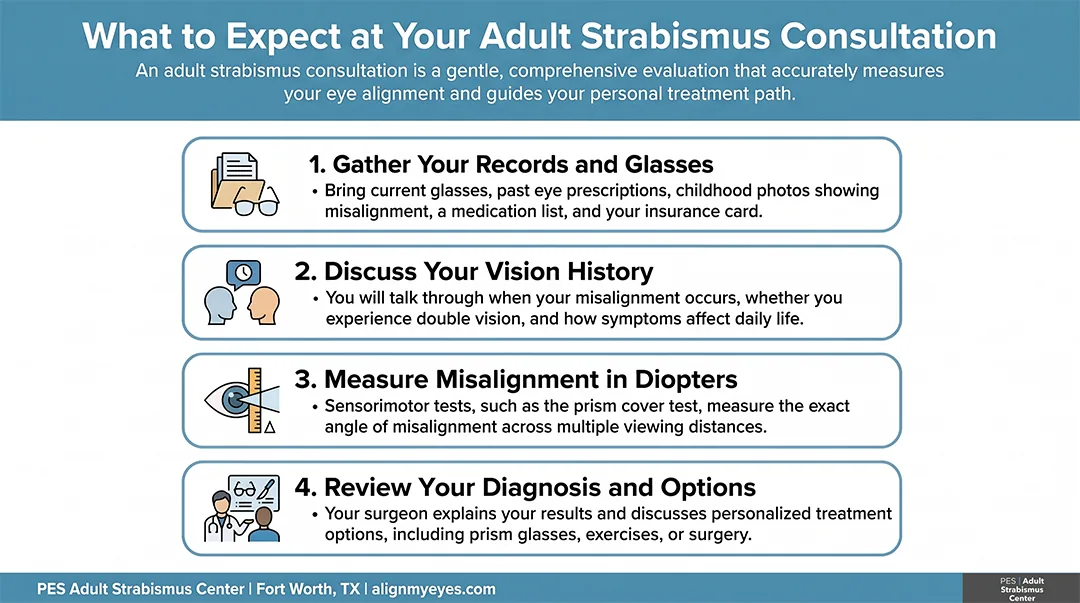
Bring your current glasses, any old prescriptions or records, a list of your medications, and your insurance card. At PES Adult Strabismus Center, we also find it helpful when patients bring a childhood photo that shows the eye misalignment, along with sunglasses and a driver in case your eyes are dilated.
- Your current glasses, including any prism glasses, and your contact lens case if you wear contacts
- Old glasses prescriptions and records from any childhood eye surgery or patching
- A childhood photo that shows your eye misalignment
- A list of your current medications
- Your insurance card and photo ID
- Sunglasses and a driver, in case your eyes are dilated
What Questions Will the Specialist Ask?
Your specialist will ask when your eye misalignment started, when you notice it most, and whether you see double. At PES Adult Strabismus Center, we ask these questions because your answers point toward the cause of the misalignment and help us decide which measurements matter most for you.
Think of this part of the visit as a friendly conversation. We will want to know whether your misalignment is constant or comes and goes, whether it gets worse at distance, up close, or when you are tired, and whether you have double vision (diplopia). We will also ask about past eye surgery and health conditions such as thyroid disease, diabetes, stroke, or a head injury. It helps to share how your signs and symptoms, like eye strain, affect your everyday life, since that information shapes your plan. If you have taken our Self-Test, many of these questions will feel familiar.
How Is Eye Misalignment Measured?
Eye misalignment is measured with the prism cover test, which tells us the size of your eye misalignment in units called prism diopters. At PES Adult Strabismus Center, we take these measurements at distance, up close, and in several directions of gaze to build a complete picture of your alignment.
This is the heart of the visit. Most of the tests simply ask you to look at a target while your examiner holds small tools in front of your eyes.
The Cover Test
You will look at a small picture while the examiner places a paddle in front of one eye and then the other, watching to see whether the uncovered eye shifts to find the target. This shows whether your misalignment is present all the time (tropia) or appears only when the brain stops holding both eyes in line (phoria). During the alternate cover test, the paddle moves back and forth between your eyes to bring out any hidden drifting.
The Prism Cover Test
Next, the examiner holds a prism bar, a clear, ruler-like tool made of prisms that gradually get stronger, in front of one eye while moving the cover back and forth. The target may seem to jump a little, which is normal. When your eye stops moving, that prism strength becomes your measurement. For many adults, it is the first time anyone has put a real number to an eye misalignment they have lived with for years.
What Is a Prism Diopter?
A prism diopter is a unit that describes how much a prism bends light, and one prism diopter shifts an image one centimeter at a distance of one meter. Smaller measurements are called small-angle deviations and larger ones are called large-angle deviations. Your measurements guide the plan, and your surgeon will explain what your numbers mean.
Why You’ll Be Measured at Distance, Up Close, and in Different Directions of Gaze
We measure your eye alignment at distance and near and in different directions of gaze as needed to understand your specific type of strabismus. Misalignment that stays the same in every direction is called comitant, while one that changes with gaze (incomitant) can point toward a specific muscle or nerve.
Eye Movement Testing
You will follow a small light with one eye covered (ductions) and then with both eyes open (versions). This shows how well the six extraocular muscles that move each eye are doing their jobs.
Testing How Your Eyes Work Together
For the stereo test, you wear polarized glasses and look at a booklet, such as the Titmus fly or Randot dot patterns, to measure your depth perception, an important part of visual perception. For the Worth four-dot test, you wear red-green glasses and tell us how many lights you see, which shows whether your eyes blend images, see double, or rely on suppression, when the brain tunes out the image from one eye. We may also measure your fusional amplitudes, or how far your eyes can stretch to keep a single image.
Extra Tests for Vertical or Complex Misalignment
Some patients with a vertical misalignment (hypertropia) need a few extra steps. A Maddox rod is a red lens that turns a light into a line so you can describe where it appears, and the Parks three-step test uses simple head tilts to pinpoint which muscle is involved. A Hess screen can also map how your eyes move together.
The In-Office Prism Trial
If you have double vision, we may hold prisms over your glasses to see whether the two images come together. This previews whether prism glasses could help and shows your surgeon what alignment your brain is comfortable accepting. For many patients, it is one of the most encouraging moments of the whole experience.
Request Your Consultation Today!
Receive a call from our senior leadership team before your appointment.
Will My Eyes Be Dilated?
For most adult consultations, the eyes are not dilated. However, depending on your medical history and examination findings, in some cases your doctor may recommend dilation to evaluate the health of your eyes. If an updated glasses prescription is needed, this is typically obtained through your primary optometrist or ophthalmologist.
Dilating eye drops widen your pupils so your doctor can look inside the eye. For some patients with an inward misalignment (esotropia), a cycloplegic refraction also checks whether farsightedness plays a role. Close-up vision is usually blurry and light may feel bright for about four to six hours afterward.
Will I Need Any Other Tests?
Sometimes, depending on what the exam shows. At PES Adult Strabismus Center, most patients get everything they need from the consultation itself, though a few may need additional testing to document how the misalignment affects their vision or to look more closely at an underlying cause.
Some patients with an inward misalignment have a visual field test to show how much side vision is affected. For a newer eye misalignment with certain findings, your doctor may recommend imaging or bloodwork through neurology or your primary care doctor. Sudden-onset double vision or eye misalignment may require prompt medical evaluation to rule out an underlying neurologic or other medical condition.
What Happens After the Measurements?
Once your measurements are complete, your surgeon will sit down with you to explain the type and size of your eye misalignment, what is likely causing it, and your treatment options. At PES Adult Strabismus Center, we want you to leave understanding your diagnosis and feeling confident about your next step.
You will learn whether you have an outward misalignment (exotropia), an inward misalignment (esotropia), a vertical misalignment, or a combination. Treatment options may include observation, prism glasses, targeted eye exercises for select conditions such as convergence insufficiency, Botox, or strabismus surgery. If one eye has reduced vision from childhood amblyopia, your surgeon will also explain that aligning the eyes does not reverse that visual impairment, so you know what to expect. You can read more on our Lazy Eye Surgery page.
How Long Does an Adult Strabismus Consultation Take?
Most adult strabismus consultations take about two to three hours, and visits that include dilation tend to run toward the longer end. At PES Adult Strabismus Center, that time comes from the number of careful measurements we take, not from sitting in a waiting room.
Do I Need a Referral to See an Adult Strabismus Specialist?
Many patients can schedule a consultation without a referral, although some insurance plans, especially HMO plans, require one. At PES Adult Strabismus Center, many patients also come to us through optometry, and our team is happy to help you check what your plan requires before your visit.
Frequently Asked Questions About Adult Strabismus Consultations
Does the Strabismus Exam Hurt?
No. Nearly every part of the exam involves looking at targets while your examiner holds paddles, prisms, or lights near your eyes, and nothing touches the surface of your eye. The only part some people notice is a brief sting from the dilating drops, followed by a few hours of blurry close-up vision.
Will I Get My Measurements in Writing?
Your measurements become part of your medical record, and you are welcome to ask for a copy. Your surgeon will also explain them during your visit in plain, everyday language, so you leave understanding what the numbers mean and how they shape your treatment plan.
What If My Eye Misalignment Wasn’t Visible During the Exam?
This is common with a misalignment that comes and goes. Your examiner can use the alternate cover test to bring out hidden drifting and may check you again after your eyes have been working for a while, since fatigue often makes a misalignment appear. Photos or videos that show your misalignment at home are also very helpful.
Is the Consultation Covered by Insurance?
Strabismus is a medical condition, and most health insurance plans cover a strabismus evaluation. Your exact costs depend on your plan, and our team can help you understand your benefits before your visit. Learn more in our article, Will Insurance Cover My Strabismus Surgery?
Take the First Step Toward Real Answers
For many adults, a strabismus consultation is the first time anyone has measured their eye misalignment and explained it clearly. Leaving with real numbers and a specific plan replaces years of hearing “nothing can be done” with options you can actually consider. Request a consultation with PES Adult Strabismus Center at our office, or take our Self-Test to see if a visit is the right next step for you.
Medically Reviewed By:
Alan A. Norman, MD
Board-Certified Ophthalmologist
Fellowship-Trained Pediatric Ophthalmology and Adult Strabismus
Last reviewed October 13, 2026

Michael G. Hunt, M.D., is a board-certified ophthalmologist with fellowship training in pediatric ophthalmology and adult strabismus. He treats adults with misaligned eyes at PES Adult Strabismus Center. He earned his medical degree at Baylor College of Medicine and completed his ophthalmology residency and fellowship at the University of Iowa Hospitals and Clinics. He joined Pediatric Eye Specialists in 2004 and is Research and Education Director of Ophthalmology at Cook Children’s Medical Center.